

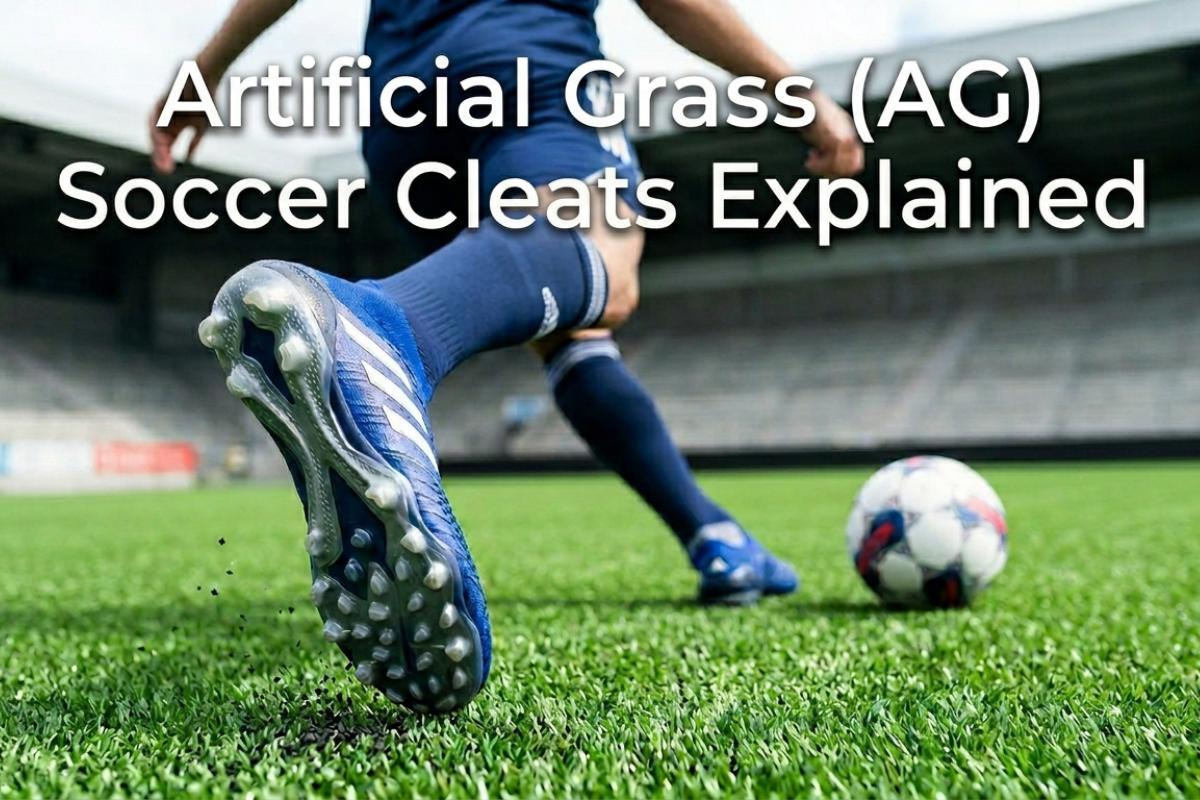
A while ago, playing soccer meant grinding your soccer cleats against grass and mud. However, as 3G and 4G synthetic fields are becoming the new norm, the era of natural turfs is disappearing.
This change in playing conditions requires a change in gear as well. Artificial grass (AG) cleats aren't just another addition to your boot collection; they have the design, materials, and technology needed to master artificial fields.
Browse our footwear collection here →
The Engineering Behind AG Soleplates

When you look at a pair of cleats, the upper usually gets all the glory, but the soul (literally) of the boot is the outsole. The fundamental difference between Firm Ground (FG) and Artificial Grass cleats lies in how they interact with the sub-surface. Traditional FG plates are designed to penetrate soil and grass. On a synthetic pitch, however, there is no "give" in the ground. This leads to "stud lock," where aggressive blades or long studs get stuck in the mesh backing of the turf. AG engineering replaces those aggressive blades with a system designed to sit on and in the synthetic fibers rather than stabbing through them.
Shop our AG soccer cleats collection here →
Traction, Stud Pressure, and Injury Prevention
The most critical reason to choose AG cleats is safety. The AG stud pattern is a masterpiece of sports science aimed at keeping you out of the physio's office.
- Stud configuration: Unlike FG boots that might have 10 to 12 long studs, AG plates feature a higher density of shorter, secondary studs. Many of these are hollowed out to reduce weight and increase the surface area of contact.
- Joint safety: Because synthetic turf has high friction, a long FG stud can "bite" too hard. When you try to pivot, your foot stays planted while your knee turns—a recipe for ACL, MCL, and ankle disasters. AG plates allow for a smoother rotational release, letting you "slide" out of a turn safely.
- Pressure distribution: Long studs can cause "stud pressure" on hard synthetic bases, which means you can feel every impact on the ball or heel of your foot. The dense AG configuration spreads your weight evenly across the whole plate, so you won't feel sore after a 90-minute shift on 4G.
Durability: Combating Abrasive Surfaces and Heat
Synthetic turf is essentially a massive sheet of plastic and sandpaper. It is incredibly harsh on footwear, which is why durability is a key pillar of the best artificial grass soccer cleats.
- Abrasion resistance: The friction between the ball, the turf, and the boot can shred premium K-leather or thin knits in weeks. AG-specific boots often feature a reinforced "lip" or a "sandpaper" texture around the toe cap to prevent the upper from separating from the soleplate.
- Heat management: If you’ve played on a hot July afternoon, you know that black rubber infill (the "crumbs") can reach temperatures exceeding 120°F (49°C). This heat can melt the glue on standard FG boots, leading to "sole separation" or delamination. AG boots utilize specialized, high-heat resistant adhesives designed to survive the thermal challenges of modern turf.
- Material integrity: While you might be tempted to wear your flashy new FG boots on turf, the friction will likely cut their lifespan in half. A dedicated AG boot is built with stiffer, more resilient plastics that don't wear down as quickly against the abrasive synthetic blades.
Better Results: Speed and Agility on Turf
Beyond safety and durability, AG cleats offer a tangible performance edge. In the high-speed world of soccer in 2026, every millisecond counts.
- Explosive movement: Because the studs are shorter, your center of gravity is lower. This "lower to the ground" feel provides superior stability during high-speed lateral cuts and explosive sprints. You feel more "connected" to the pitch, allowing for more confident movements.
- Energy return: Modern 2026 models feature carbon-fiber or TPU-injected midsoles. These are specifically tuned to the "bounce" of 3G/4G pitches, absorbing impact and snapping back to propel you forward.
- Consistency: Natural grass can be unpredictable—too dry and it’s like concrete; too wet and it’s a swamp. Synthetic pitches offer a consistent level of grip. AG cleats are designed to provide a predictable, uniform level of traction whether the pitch is bone-dry or recently watered for a "pro-speed" surface.
Strategic Selection: Choosing Your AG Boot

When you browse footwear, look for the "AG" or "MG" (Multi-Ground) designation.
- Elite models: These are the "pro" versions featuring the lightest materials and most advanced energy-return plates. Perfect for competitive players who want the absolute best.
- Pro/Academy models: These offer a middle ground, providing the same AG stud pattern but with slightly heavier, more durable materials that are easier on the wallet.
- Club models: Ideal for the casual player or beginner, focusing on comfort and surface-specific safety.
Check out the latest soccer footwear arrivals on ProSoccer →
Artificial Grass Cleats FAQs
1. Can I wear AG cleats on natural grass?
Yes, but with a caveat. AG cleats perform best in dry, firm natural grass, but if the ground is soft or wet, the short studs of AG won't provide enough penetration. As a result, you’ll likely slip often during turns or accelerations.
2. Why do FG boots often break faster on artificial turf?
The high friction and heat of synthetic turf act as an accelerant for wear and tear. FG boots lack the reinforced toe-stitching and heat-resistant glues found in AG cleats, leading to the soleplate peeling away from the upper much sooner than expected.
3. What is the difference between AG and Turf (TF) shoes?
AG cleats have a studded plate designed for "long" synthetic grass (3G/4G). Turf (TF) shoes have a flat, dimpled rubber outsole designed for very thin, carpet-like turf (2G) or indoor facilities. For most modern outdoor synthetic pitches, AG is the superior choice for traction.


