

Trying to understand soccer when starting to play can become overwhelming. Everyone talks in a language you don't seem to understand. They throw in soccer terminology, abbreviations, and slang that can make a new player feel like everyone is speaking a different language. A language they don't understand.
But there is no need to worry. Soccer terminology is not as complicated as it may sound in the beginning. You just need to understand the basics and everything will start coming together.
What Are The Basic Rules of Soccer?
First things first, before you start talking tactics and fancy team structures, you need to understand the layout of the field and what all those lines are for. Learning these basics makes so much easier to follow a game or jump in to play.

The long sides are called touchlines and the shorter lines at each end of the field are called goal lines.
A typical pro soccer match lasts 90 minutes, split into two 45-minute halves. Depending on the actual age group, the length of youth soccer games can be dramatically shorter. The clock stops for nothing during play. Instead, the referee takes note of the time lost by injuries or substitutions. The referee adds stoppage time at the very end of each half.
If the ball travels completely over a touchline, play restarts with a throw-in, where a player must throw the ball using both hands while keeping both feet firmly on the ground.
When the attacking team kicks the ball past the opponent's goal line, play restarts with a goal kick from the six-yard box. Conversely, if the defending team knocks it out over their own goal line, the attacking team is awarded a corner kick from the nearest corner arc.
Ready to hit the pitch? Gear up with everything they need for a competitive match. Explore our complete Soccer Equipment Collection to find premium jerseys, shorts, and performance apparel.
Decoding Crucial Soccer Game Concepts
Soccer terminology extends far beyond simple field boundaries and basic out-of-bounds restarts. The game is highly strategic, and a few specific regulations dictate how teams defend, attack, and position themselves throughout a match.
The Offside Rule, Set Pieces, and Tactical Terms
The most infamous rule among soccer players is the offside rule.

Offside happens when a player receives the ball from another teammate and is closer to the opponent's goal line than the ball itself and the second-last defender (usually the last defensive field player). The offside rule will prevent "goal-hanging," and teams will have to play based on passing the ball. They won't be hanging around the net.
If a foul is made by either team, the referee will give them a set piece. It may be either a direct free kick, which allows scoring a goal right away, or an indirect free kick, which means that another player should touch the ball first to make a goal valid.
In case of any serious fouls within the big penalty area of the defenders, the attacking team gets a penalty kick.
Tactically, coaches often talk about keeping a clean sheet, which simply means keeping a shutout and not allowing the opposing team to score any goals during the match. When an individual player scores three goals in a single game, the achievement is celebrated as a hat trick.
Whether you are playing on wet natural grass or modern artificial turf it's important to use the right soccer cleats. Check out our Soccer Cleats Collection and find your pick.
From Goalkeepers to Forwards: Soccer Roles Explained
| Position | Common Abbreviations | Standard Player Count | Main Responsibility on the Pitch |
| Goalkeeper | GK, Keeper | Exactly 1 | Protects the net; only player allowed to use hands/arms (only inside the penalty box). |
| Defenders | CB (Center-Back), FB (Full-Back) | Typically 4 (usually 2 center-backs, 2 full-backs) | Stops opposing attackers, guards the flanks, and clears the ball from danger. |
| Midfielders | Mids, CM, AM, DM | 3 to 5 players | Dictates the tempo, wins back possession, and links the defense to the attack. |
| Forwards | Strikers, Wingers | 1 to 3 players | Stays closest to the opponent's goal to convert chances and score goals. |
Note: A team's total lineup always equals 11 players. Tactical formations (like a 4-4-2 or 4-3-3) list the numbers for defenders, midfielders, and forwards in that specific order. The 1 goalkeeper is always assumed.
Common Terms in Soccer
- The Beautiful Game: Pelé’s famous nickname for soccer.
- Box-to-Box: A midfielder tracking back and crashing forward.
- Volley: Striking the soccer ball out of the mid-air with your foot before it bounces on the ground.
- Nutmeg: Dribbling or passing the ball directly through a defender's legs.
- Wall: Defenders standing shoulder-to-shoulder 10 yards out to block a free kick.
- Man On!: Teammate warning that a defender is approaching from behind.
- Upper 90: The top corners of the goal net.
Soccer FAQ's
Is a yellow card different from a red card?
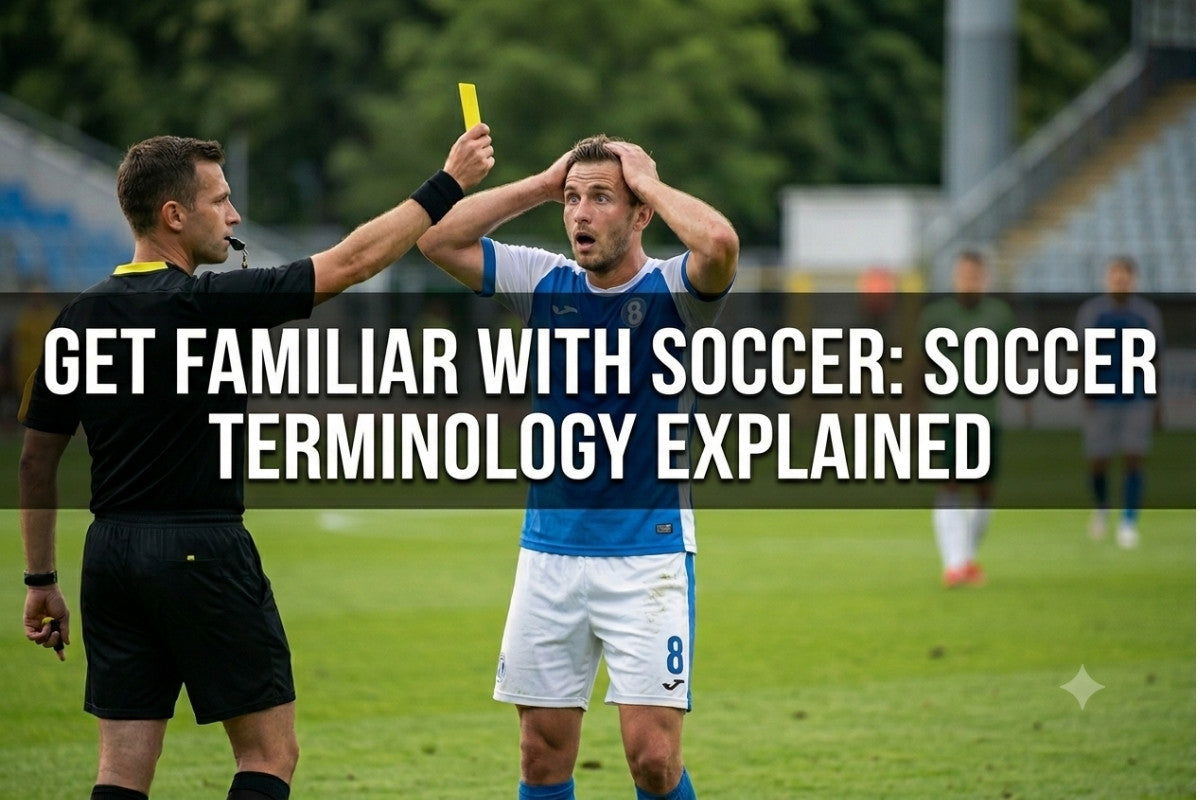
A yellow card is given to warn a player about his reckless performance on the pitch or tactical fouls. But if a player is issued with two yellow cards during the same match or makes dangerous moves against a player from the other team, he will get a red card and get sent off.
What is the difference between a direct and an indirect free kick?
On a direct free kick, the attacking player can shoot and score a goal immediately without anyone else touching the ball. On an indirect free kick, indicated by the referee holding one arm straight up in the air, the ball must be touched by another player before a goal can legally be scored.
What is “unintentional handball” during a game?
Handball occurs when a player makes use of their hand or arms in an attempt to control the ball. However, if the ball hits the arm of a player when it is held in a natural manner pressed against the body, it is considered unintentional.
_____________________________________________________________________________
What are the basic rules, positions, and common soccer terms needed to understand soccer terminology for beginners?
- Field & Boundaries: The game is played on a pitch. The long boundaries are touchlines (restarts via throw-ins) and the short ends are goal lines (restarts via goal kicks or corner kicks).
- Rules & Restarts: Soccer matches last 90 minutes plus stoppage time. Offside prevents attacking players from sticking to the goal behind the last defender. Fouls result in direct free kicks, indirect free kicks, or penalty kicks.
- Positions: Soccer teams have one goalkeeper (uses hands inside the penalty box), 3 to 5 defenders (center-backs and full-backs), 3 to 5 midfielders (the transition engine), and 1 to 3 forwards (strikers who score).


